Flora
Handling the UndeadFlora’s life is shaped by two forms of intimacy: the ordinary bonds of family and friendship, and the uncanny ability she shares with her grandmother, Elvy. As the crisis of the returned dead intensifies, that sensitivity becomes more than a way of sensing others; Flora comes to understand it as bound up with death itself, and ultimately uses it to reach Eva.
Identity and Early Relationships
Flora is the daughter of Margareta and the granddaughter of Elvy. She is close to Elvy, who welcomes her into her home and makes space for her after Flora’s parents object to how much time she spends playing video games. Flora had been spending three, four, or five hours a day on the GameCube for six months when her parents gave her an ultimatum: the console had to be sold or moved to Elvy’s home. Elvy agreed to keep it. Flora then visited two or three evenings a week, usually playing for a couple of hours; their visits also included tea, conversation, cards, and sometimes an overnight stay. Their shared routines make Elvy not simply a relative who accommodates Flora, but a trusted companion.
That closeness gives Flora somewhere to bring experiences she cannot readily share elsewhere. About two years before the crisis, she and Elvy had spoken about having the Sense. Flora’s experience had left her feeling alone in it; discovering that Elvy possessed the same ability was a relief. The Sense is difficult to describe, closer to an impression of scent than a clearly defined perception. The two women can nevertheless discern something lingering around people and places, as an animal might detect the presence and fear of prey in the dark. In a society that would neither recognize them as shamans nor treat their sensitivity as ordinary, Flora and Elvy find in one another confirmation that the experience is real to them.
Their connection also appears in the ease with which Flora and Elvy can register what is passing through each other’s minds. While Flora is thinking through a plan in a video game, Elvy unexpectedly asks whether she had been thinking about a shotgun and dogs. Flora laughs in surprise: Elvy has perceived the substance of her thoughts without being told. The moment makes the Sense concrete through a familiar domestic scene, while hinting at how profoundly their shared perception may matter beyond the game.
Fear, Self-Protection, and Family
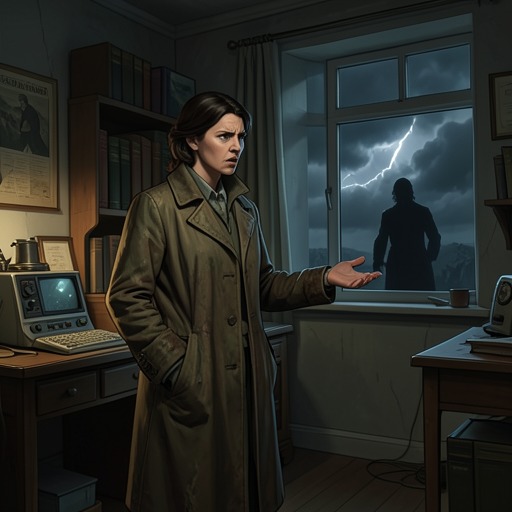
When Tore returns, Flora sees the danger before she can make sense of it. Elvy tries to stop him, but her gaze no longer reaches him; he moves toward the bedroom with no sign of recognition or feeling. As he slips from Elvy’s grasp, Flora comes out of the room and catches sight of him. She whimpers, throws herself aside, and scrambles around an armchair toward the balcony door while Tore continues past her. The encounter is a sharp break in the ease of the household: the grandfather she knows has become a force she can neither speak to nor hold back.
Flora’s response changes when the immediate shock gives way to questions. Elvy is astonished to hear her speak normally and methodically, counting possibilities on her fingers. Flora asks whether Tore is truly dead and, if so, what brought him back, including whether it might have something to do with what happened in the garden. Her composure does not erase the fear of the encounter; it gives her a way to examine it. The scene also reveals a more analytical side beneath the appearance Elvy usually sees her suppress: Flora can turn from panic toward investigation, even when the subject is her own family.
The crisis reaches into a history of pain that Flora has kept private. Alone in her room, she takes a razor blade from a DVD case after lying on her bed and feeling at peace in her hunger. The scars on her arms came from an earlier period of cutting; she later moved to places beneath her collarbones and on her shoulder blades. Two of those scars were so deep they resembled wings cut away. When one wound would not stop bleeding, the experience frightened her. Around that time, she spoke with Elvy, and life became slightly more bearable; the wing-like scars were the last. The account connects Flora’s bond with Elvy to more than shared perception: their conversation had helped her endure a period when her own body became a site of danger.
Defiance and the Approach to The Heath
Flora’s sense of being out of step with other people takes a deliberately theatrical form online. At her computer on Bondegatan, she joins a Christian chat forum and presents a satanist’s case about the returned dead, inventing black masses in her congregation at Falkoping to hasten Beelzebub’s arrival. The prank was funniest while other users still believed she was a devout evangelical who had seen the light—or the dark. By the time Margareta comes home, Flora knows she has pushed the performance so far that the others are trying to bring her back into line and no longer trust the persona she began with. She signs off, then waits for the familiar rustle of her parents’ shopping bags: provocation and ordinary domestic routine occupy the same small interval.
That sense of distance does not mean Flora has no attachments beyond Elvy. Maja, one of the few friends she has at school, arrives at Flora’s apartment on Saturday morning and asks her to come out. Maja’s army-surplus greatcoat and confrontational religious button announce a similarly conspicuous outsider style, though the evidence establishes the invitation rather than what the two girls do afterward. Flora’s social world is small, but it is not empty; friendship can reach her at the door even as she cultivates a voice designed to unsettle people online.
At The Heath, that mixture of loyalty and separation becomes practical. Flora arrives hoping to enter the enclosed area, but she does not share her grandfather’s surname and has no document to prove her connection to him. She had called Elvy that morning for a signed paper, only to be told by a staff member that Elvy was busy. The gate turns family relation into a question of credentials: Flora knows who she is trying to reach, but cannot make that knowledge count for the people controlling access.
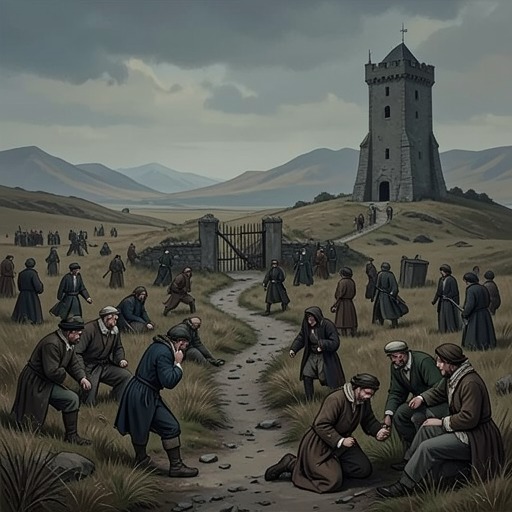
Her effort is also an act of care for Peter. He has stayed hidden in his basement through the clearance, but his battery has gone flat, leaving him unable to get to a source of electricity while the area remains under intense activity. Flora carries a backpack full of fruit for him as she inches forward in the queue. To endure the wait, she counts prime numbers, a small, self-imposed pattern against the fear she senses among the people around her. The fence, at least three kilometres long and erected in two days, and the military presence make the boundary feel less like an ordinary entrance than a rapidly constructed barrier around an unknown danger.
At the gate, Flora witnesses another family trying to establish its claim. A man names Eva Zetterberg; when asked who he is, he identifies himself as her husband and points out their son and her father. Flora then names Tore Lundberg and says she is his granddaughter. The guard appraises her appearance and asks for proof. In a crisis where families converge on The Heath to reach the dead, Flora’s connection to Tore is both intensely personal and institutionally insufficient. She has come with food for a friend and a claim of kinship, but neither care nor kinship guarantees passage.
The Heath, Death, and the Power to Release
As Flora enters The Heath, the Sense she shares with Elvy becomes overwhelming in scale. With every step toward the buildings, she feels the field thicken, changing from something like streams passing through her head into a fog of many consciousnesses. Within it, individual thoughts emerge as faint but distinct cries, while a deeper presence seems to think nothing at all. Expressions of horror intensify the field, like an electrical conductor warming as current passes through it. What Flora encounters is not simply a collection of frightened people: fear itself appears to enlarge the force surrounding them.
The field also turns Flora’s attention back upon herself. Straining her neck as if lifting a heavy load, she sees another girl moving away across the yard: a double in the same oversized outfit, carrying the same backpack and wearing the same straggly red hair. The difference lies in the shoes. The double wears Flora’s favorite sneakers, once broken, but intact on her. The apparition makes the encounter with death intimate and self-directed, rather than an abstract vision of the crisis outside her.
A memory Peter has shared gives the vision its meaning. He once cycled along a gravel road between spruce trees and found a large wolf with yellow eyes five metres ahead. Certain it was about to kill him, he could not scream; the wolf watched him, then returned to the forest. The terror was so physical that he wet himself and could not move for several minutes. As Flora receives the memory, she recognizes that what she had treated as imaginative play expresses her own deepest belief: she herself is Death. Her idea of Death as a twin sister had begun years earlier, when she tried to summon the Dark Lady before a mirror with a candle and saw only herself. The double at The Heath gives that private image a new force.
That recognition does not leave Flora detached from the living. Later, amid the mass of tangled bodies at The Heath, she is confronted by the consequences of the crisis she had once wished to witness without knowing what it would become. When she reaches apartment C, Eva Zetterberg is in the hallway, bandaged over half her face and on her way out. Flora steps forward and takes her by the shoulders. Through the link that forms between them, Flora shuts out what is happening around them and addresses what remains of Eva within her body.
Eva answers that she wants to live. Flora responds that the body’s path is closed and conveys two possible departures for the soul: one in which it is collected, and another in which it disappears. The words pass through Flora rather than seeming to originate in her. The encounter brings together her family ties, her sensitivity to other minds, and her new understanding of herself as Death: she uses that understanding not to threaten Eva, but to make the alternatives of release perceptible to her. The evidence leaves Eva’s answer unresolved, preserving the difference between Flora’s ability to reach her and the choice Eva must face.